Phil Foster

Phil has a fair sized library about old cars, and is something of an authority on the history of the automobile.

The manufacture of automobiles in North America started about 1895.  It was 1900 before American factories turned out vehicles in any quantity.  Henry Ford founded his company in 1903.

Some 2,000 different makes of cars have been made on this continent.  This total included 100 makes of electric cars, 125 steam cars, such oddities as the Reeves Octo-Auto, which had eight wheels, four in line at each side; the Metz Friction Drive, which had no transmission or clutch and passed along its power through a small friction wheel sliding on a large face-plate; and the Owen Magnetic, which had an electric coupling between motor and rear axle.

One manufacturer named his product, with fine simplicity, “Rigs That Run.”  Another early-day car snorted along under the name of “Seven Little Buffaloes.”

In the parade of vanished car names were Autobug, Autogo, Bacon, Blood, Dan Patch, Foos, Henrietta, Sun, Moon, and Star.

What may have been history’s longest automobile race was the New York to Paris marathon in 1908.  Competitors drove from New York to Seattle; took a boat to Vladivostok; then drove through Siberia to Paris.  The total distance was 21,000 miles, of which 13,000 was on land.  The winning car, a Thomas Flyer, got there in seven months.  For 8,000 miles it never got out of low gear.

Foster Collection
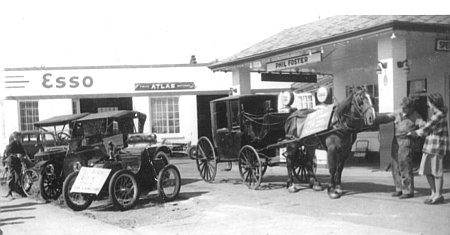
During the fifties, Speedway Station featured a fascinating variety of vehicles

Phil Foster claims he has a poor memory and depends a great deal upon books for information like that; but he seems to have a massive store of facts.  Phil, a short, dark man, conducts a visitor through his collection of cars and comments briefly on each in his slow, deliberate voice without any display of enthusiasm.


BY THE WAY

Every now and then he stops to make an illuminating remark.  He points out that many of the supposed “new” features of modern cars are revivals of old gadgets that were shelved; recalls that up to 1910 such items as windshields, headlights and tops were optional and cost extra; that early tires were good for only 3,000 to 10,000 miles, and three to five punctures a day were not unusual; that a Stanley Steamer set a speed record of 120 miles an hour, in 1907.

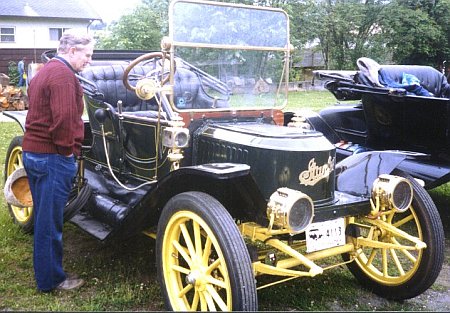
One of the most prized cars in his collection is a 1910 Stanley. Under its hood is nothing but a big boiler, heated by a gasoline flame (later kerosene was introduced).  Steam is piped direct to a two-cylinder engine on the back axle.  There is no clutch, no transmission.  The engine develops tremendous power.  It takes half an hour to build up enough steam, before it can be started.  It is completely safe. 1910 Stanley
Phil's 1910 Stanley is still seen at Antique Chapter events