
“Until 1909 or 1910, there were more steam and electric cars on the road in North America than gas cars,” Phil says. His other cars include a one cylinder De Dion, 1900 (“Little Lulu”) steered by a tiller instead of a steering wheel; the 1906 Model ‘N’ Ford, with its gleaming brass lamps - carbide headlights and oil side lamps with handles on them so they could be lifted off and used as trouble lamps; and a 1910 Russell touring car which Phil Foster took over to Vancouver to drive around James Melton, opera star and antique automobile collector, as part of the British Empire Games publicity. |
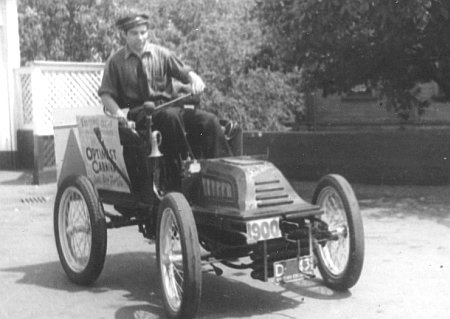 The 'DeDion' has since been correctly
identified as a 1902 Holley
|
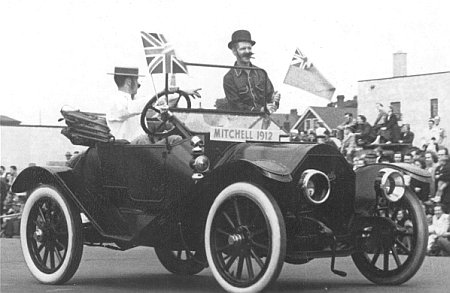 |
There is a 1912 Mitchell roadster, being reconditioned. The giant 34 by 4 ½ tires, carrying 70 pounds pressures, were hard to get, but Phil located a few of them up-island; and now Harvey Firestone, an antique car zealot himself, is making various outsize tires specially for the cars that need them. |
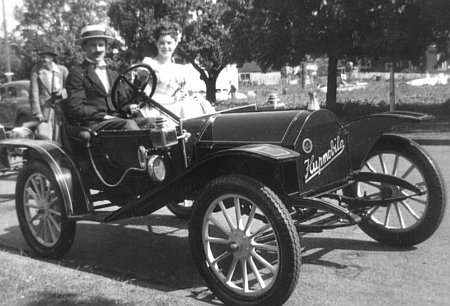
There is a 1910 Hupmobile and a 1910 Buick awaiting beauty treatment. Housed elsewhere are a three wheel English Auto-Carrier; a 1912 Detroit Electric run on batteries (once the property of the late Cecil French); a 1923 Franklin air-cooled; and a 1912 Model T in which Mr. and Mrs. Foster and Mr. and Mrs. Scroggie went on a tour of Washington State four years ago, for fun. |
 |
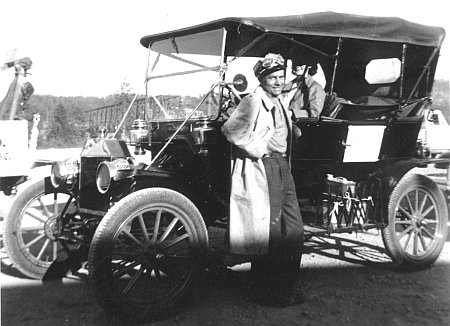 Phil Foster and "Elizabeth," his 1912 Model T Ford which is now on display in the Royal British Columbia Museum in Victoria |
They got a cordial reception everywhere. It is another of Phil Forster’s dreams to persuade an antique car club from the U.S. to make Victoria a stopping place for an international tour. One difficulty about this is licensing. Few aged cars are licensed. Some American states allow antique cars (generally, by definition, 1912 or older) a special $10 licence, good for the lifetime of the vehicle. Since these cars are seldom driven, they do not place much burden on the roads. No such special rate has yet been granted here. |
 |
 |
 |